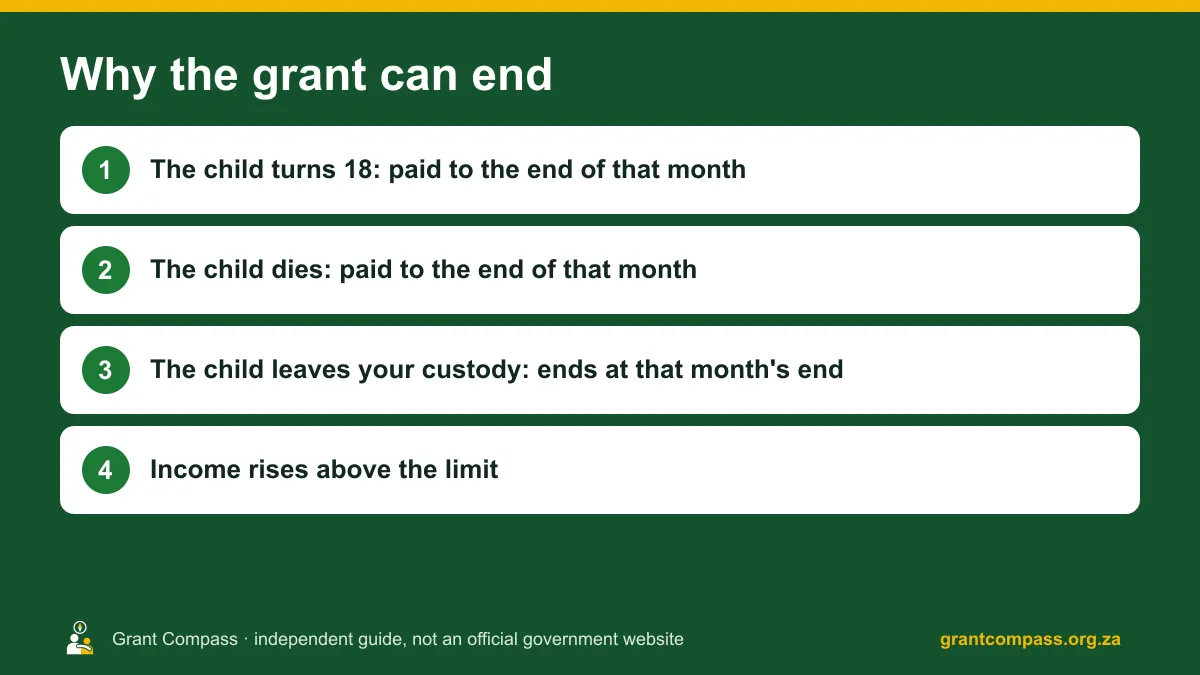
The child support grant stops at the end of the month in which the child turns 18. It can end earlier if the child dies or leaves your custody, or if you no longer qualify. If a caregiver dies, the person now looking after the child should contact SASSA immediately.
Contents (13 topics)
- What made your payment stop?
- Does the grant stop on the 18th birthday?
- What if the child is still at school at 18?
- What else can end the grant before 18?
- Does missing school stop the grant?
- Can the grant stop because you earn more?
- What is the difference between lapsed and suspended?
- What happens when the caregiver dies?
- What if relatives argue about who cares for the child?
- How do you challenge a wrong decision?
- Tips for avoiding a surprise stop
- Frequently Asked Questions
- Your best next step
What made your payment stop?
Match your situation to the table before you travel anywhere. It shows whether the end is expected or something you can challenge.
| What happened | What it means | What to do |
|---|---|---|
| Child turned 18 last month | Expected end | Plan for other support |
| Child moved to another carer | Your grant lapses | New carer approaches SASSA |
| Caregiver died | Another person must take over | Report and ask to be appointed |
| Review or documents missed | Possible suspension | Apply for restoration quickly |
| Income went up | You may no longer qualify | Check the limit and ask for reasons |
| Nothing changed | Possible error or payment problem | Ask SASSA for the exact reason |
If the status looks fine but no money arrived, the problem may be the bank route. See Money not landing and check the Child grant payment dates.
Does the grant stop on the 18th birthday?
No, it does not stop on the birthday itself. The regulations say it lapses on the last day of the month in which the child turns 18.
| Child turns 18 | Payable until | No longer payable from |
|---|---|---|
| 1 February 2027 | 28 February 2027 | March 2027 |
| 15 May 2027 | 31 May 2027 | June 2027 |
| 30 September 2027 | 30 September 2027 | October 2027 |
| 20 December 2027 | 31 December 2027 | January 2028 |
Write the last month down for each child. If you receive grants for other children, those continue on their own rules.
What if the child is still at school at 18?
The child support grant still ends. The regulations give no extension for a learner who has not finished matric.
This differs from the foster child grant. A provincial decision can allow some foster children to stay in care to finish education or training, up to the end of the year they turn 21. Do not assume that rule applies to a child support grant. Compare the two in our Foster child grant guide.
At 18, the young person may be able to apply in their own name for the R370 SRD grant, if they meet all its conditions. The SRD application guide explains them. Our page on No-fee schools and fee exemptions may also ease school costs.
What else can end the grant before 18?
The grant can end when the child dies, leaves your custody or when you stop qualifying. A refugee caregiver's grant also lapses if refugee status ends.
- Death of the child. The grant is payable to the end of that month.
- Change of custody. It lapses at the end of the month in which the child is no longer with the primary caregiver.
- Income change. A caregiver continues to receive it until 18 or until income status changes.
- State institution. A child resident in a state-funded institution does not qualify.
- Long absence abroad. A stay outside South Africa of more than 90 days triggers separate rules and must be reported first.
SASSA's 2026 booklet also lists a grant not claimed within 90 days of approval and failure to update information.
Does missing school stop the grant?
You must enrol a child aged 7 to 18 in school and give SASSA proof within one month of approval. SASSA's booklet states that failing to attend or to submit proof will not result in the grant being refused.
The law instead provides for a social worker to look into why the child is not at school. Hand in the school letter anyway, so that your file is complete.
Can the grant stop because you earn more?
Yes. The child support grant has a means test based on the caregiver's income, and a spouse's income counts if you are married.
The income limit is set at ten times the yearly value of the grant. With the grant at R580 a month from April 2026, that works out to R69,600 a year for a single caregiver. That is about R5,800 a month. For married caregivers the combined limit is twice the single figure.
Certain deductions, such as tax and UIF, come off before SASSA compares your income. Read more about the Means test and confirm current figures with SASSA.
What is the difference between lapsed and suspended?
A lapse means the grant has ended, while a suspension means payment is on hold. The fix is different, so ask which word is on your record.
SASSA may suspend after a review, missing information, a mistake at approval or misrepresentation. Except in fraud cases, it must usually give 30 days' notice, reasons and a chance to explain.
If you failed to provide requested information, you have 30 working days from suspension to apply for restoration. Our guide to Getting a stopped grant back takes you through it.
What happens when the caregiver dies?
The grant should not be left unattended, because the child still needs it. The Act says SASSA must appoint a person to receive the grant for the child without suspending it, subject to set conditions.
The regulations also recognise that a primary caregiver can be replaced, including on death. In real life, do not wait for SASSA to find you. The adult now responsible should report the death, show that they care for the child and ask what to sign. If SASSA asks for a new application, make it at once.
A primary caregiver need not be a parent or relative. The person must be older than 16 and take main responsibility for the child's daily needs. A paid childminder employed to look after the child does not qualify.
How does a new caregiver take over?
- Report the death. Phone 0800 60 10 11 or visit a SASSA office.
- Gather papers. Take your ID, the child's birth certificate and the caregiver's death certificate.
- Prove care. Bring an affidavit, a school principal's letter or a social worker's letter.
- Show your income. Take payslips, bank statements or a sworn statement.
- Ask about both routes. Confirm whether you are being appointed to receive or must apply afresh.
- Keep the receipt. It shows the date your documents were accepted.
- Follow up. SASSA must give an application outcome within three months.
Warning: do not keep using the late caregiver's card or PIN. Ask SASSA and the bank how that money must be handled.
Will the new caregiver get back pay?
For a new application, SASSA's booklet says the grant usually starts from the application date, when all requirements were met. So apply early. Ask SASSA how any months around the death will be treated.
What if both parents have died?
A relative caring for an orphan may qualify for an extra monthly amount on top of the child grant. See Extra grant money for orphans. If the child also needs protection, a social worker can advise on foster care.
What if no adult is available?
A child aged 16 or older who heads a child-headed household can receive a child grant. Ask a social worker, teacher or provincial social development office for help with recognition and a supervising adult.
What if relatives argue about who cares for the child?
SASSA must decide who the primary caregiver is when more than one person claims. It looks at who actually meets the child's daily needs.
Bring evidence from people who see the child often, such as the school or a social worker. Only one person can receive the grant for that child. Keep the child's needs first while the dispute runs.
How do you challenge a wrong decision?
Ask SASSA to reconsider within 90 days of learning about the decision. If the reconsidered answer is still against you, you have 90 days to appeal.
Ask for the reasons in writing and keep your proof together. SASSA's booklet says an official can help you lodge, and gives [email protected] for normal grant appeals. For general enquiries, our Contact page lists the routes.
Tips for avoiding a surprise stop
- Mark each 18th birthday. Note the last payable month a year ahead and plan the budget.
- Report moves fast. Tell SASSA when a child goes to live elsewhere, even temporarily if it may last.
- Open every notice. Review requests carry deadlines that are easy to miss.
- Keep school letters. One copy each year helps prove enrolment and care.
- Name a backup carer. Tell a trusted adult where the child's birth certificate and grant papers are kept.
- Update your number. SASSA cannot warn you on a phone you no longer use.
- Check income changes. Compare a new salary with the limit and report it.
- Collect promptly. Do not leave an approved grant untouched.
- Ask for the reason code. "Stopped" is not enough to plan a fix.
Frequently Asked Questions
When does the child support grant stop?
It lapses at the end of the month in which the child turns 18. It can also end when the child dies or leaves the primary caregiver's custody, or when the caregiver no longer qualifies. A suspension is separate and may follow a review, missing information or an error.
Do I get paid in the month my child turns 18?
Yes, the grant remains payable for that month, because it only lapses on the last day. The following month is not payable. If your final month's money does not arrive on the usual date, check the payment status and phone SASSA with the child's details and your reference.
Can the child grant continue until 21?
No. The 18-year limit applies to the child support grant. The possible extension to 21 that you may have heard about belongs to the foster child grant, with a provincial social development decision. Ask a social worker if the child is in court-ordered foster care.
Does the grant stop if my child fails a grade?
Failing a grade is not a listed reason for the child support grant to lapse. School enrolment and attendance matter for children of school age, and SASSA may ask for proof. The booklet says missing proof will not by itself cause refusal. Keep your child enrolled and hand in letters.
What happens to the child grant if the mother dies?
If she was the primary caregiver, another person must be recognised to receive it. The Act says SASSA must appoint someone without suspending the grant, subject to conditions. The new carer should report the death immediately, prove that they look after the child and complete whatever SASSA requires.
Can a grandmother take over the grant?
Yes, if she takes primary responsibility for the child's daily care and meets the requirements, including the means test. She should take her ID, the child's birth certificate, the death certificate if relevant and proof of care. If the child is an orphan, she can ask about the top-up.
Can the father receive the grant instead?
Yes, if the father is the primary caregiver. The grant follows daily care, not gender. If the child moves from the mother to the father, tell SASSA. The old grant lapses with the change in custody, and the father should ask what he must submit in his own name.
How much is the child support grant now?
The grant is R580 a month for each qualifying child, from 1 April 2026. The amount is set by notice in the Government Gazette and normally reviewed with the national Budget. A relative caring for an orphan may also qualify for an additional R290, subject to approval.
What if the grant stopped but my child is under 18?
Phone 0800 60 10 11 and ask whether the grant lapsed, was suspended or only the payment failed. Ask for the reason and the deadline to respond. Take your ID, the child's birth certificate and any notices to the office. Apply for restoration or reconsideration in time.
Must I report the child's 18th birthday?
SASSA works from the birth date on its record, so the lapse follows that date. If the date on your grant letter is wrong, report it with the birth certificate. Do report other changes yourself, such as a move, a new carer or higher income, as soon as they happen.
Your best next step
Check the child's last payable month today. If the grant stopped early, or the caregiver has died, phone 0800 60 10 11 and ask for the exact action needed. Then visit with the documents listed above and keep your receipt.
Sources
- Social Assistance Regulations, 2022 (Government Gazette 46459)
- Social Assistance Act 13 of 2004
- Increase in respect of social grants, 2026 (Government Gazette 54397)
- SASSA grant booklet 2026 (You and Your Grant)
- Social Assistance Amendment Act 5 of 2010

About The Author
Michael Williams is an informational content writer focused on South African social grants, SASSA services and public assistance information.
Keep Reading