SASSA income verification checks whether you had money or support that puts you over the SRD means test in a given month. Banks and government records are used, and the threshold has been R624. If a deposit was not really your income, collect proof and appeal that month.
Contents (20 topics)
- If your screen says alternative income source identified, what does it mean?
- How does SASSA income verification work each month?
- What is the R624 income limit?
- Which money can raise a question?
- Can eWallet or cash send money affect your SRD grant?
- Does moving your own money between accounts count?
- How do you check what SASSA may have seen?
- What do the income-related messages mean?
- How do you appeal an income decline?
- Can you qualify again next month?
- How is this different from other grant means tests?
- What should you do about piece jobs and small trading?
- What if you share money in a household?
- What if the same month keeps being refused?
- Where can you get help with an income decline?
- How should you plan if a month is refused?
- Tips to avoid income surprises
- What if someone offers to clean your record?
- Frequently Asked Questions
- Your best next step
If your screen says alternative income source identified, what does it mean?
It means records showed money or support linked to you, and SASSA treated it as income for that month. The refusal does not always say which deposit or record caused it.
SASSA has explained that SRD applications can be declined when outside databases, including banks, show a source of income. You agree to these checks when you apply. The 2026 SASSA booklet says applying gives consent to verify income and bank accounts.
So the first job is detective work. Find what came in, when it came in, and where it came from.

How does SASSA income verification work each month?
Your eligibility is looked at again for each month, using the information available for that period. One clean month does not clear the next.
In simple terms:
- You hold an SRD application.
- SASSA matches your ID number with banks and other databases.
- It compares what it finds with the SRD rules.
- The month is approved, declined or held for more checks.
- You see the result on the portal.
Because checks can run after the money moved, the refusal may arrive well after you have forgotten the deposit.
What is the R624 income limit?
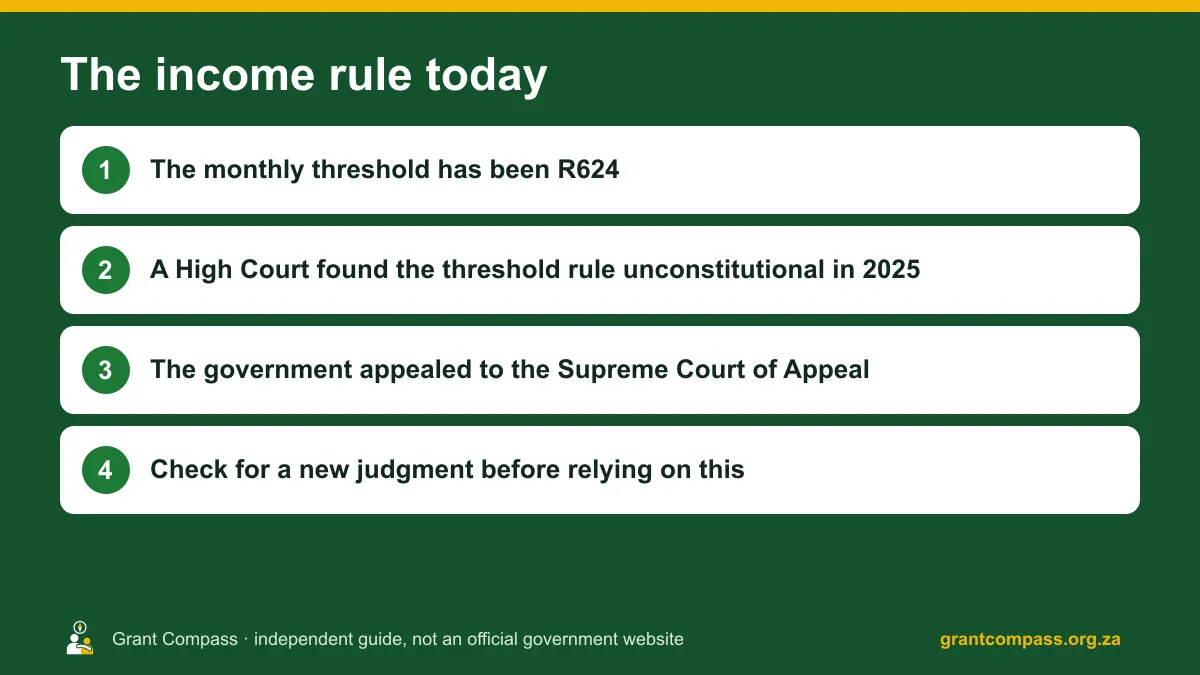
The SRD means test has used a limit of R624 a month. A person with more than that coming in for a month could be declined for that month.
This rule is under legal challenge. In January 2025 the Pretoria High Court found several SRD regulations unconstitutional, including the fixed threshold. It also found that gifts and once-off payments should not count as income. The government appealed.
The Supreme Court of Appeal heard the matter in August 2026 and reserved judgment. We found no ruling as of 26 November 2026. Until the courts finally settle it, do not assume that gifts are being ignored by the system. Check for news and use your appeal rights.
Which money can raise a question?
Any money entering an account in your name can be noticed, even when it is not pay. The table shows common examples and the proof that may help.
| Type of money | Why it can be questioned | Proof that may help |
|---|---|---|
| Wages or piece jobs | It is earned income | Payslip or written pay record |
| Selling goods | It may be business income | Sales and cost records |
| Help from family | Looks like regular support | Note from the sender, statement entries |
| Stokvel payout | A large single deposit | Stokvel records showing your own contributions |
| Loan received | Money in, though you must repay it | Loan agreement or written note |
| Repayment of your loan | Money in from another person | Earlier statement showing you paid it out |
| Refund | Money coming back to you | Shop or company refund slip |
| Own transfer | Same money seen twice | Both accounts' statements |
| Money held for someone | Passes through your account | Proof it left again, plus the owner's note |
Proof helps explain a deposit, but it does not guarantee a different result. Be ready to be honest about regular support.
Can eWallet or cash send money affect your SRD grant?
It can matter, because money sent to you is still money you received. We could not find an official list saying which wallet services are checked.
Cellphone wallets and cash send services are easy to forget, since nothing appears on a bank card statement. Do not rely on that. If a wallet or account is linked to your name and ID, treat it as visible.
What should you record for wallet money?
Write these down while you still remember:
- the date and amount;
- who sent it and your relationship;
- why it was sent;
- whether you kept it or passed it on;
- the SMS or app history that shows it.
Is receiving SASSA money by cash send the same thing?
No. Your own SRD payment is the grant itself, not outside income. If a refusal seems to count your grant as income, say so in the appeal and show the payment record.
Does moving your own money between accounts count?
It should not be new income, but an automated check may only see money arriving. This is why your own transfers need a clear trail.
Suppose you move R700 from a savings pocket to your main account. No new money came to you. On one statement it still looks like a R700 deposit.
To show it was yours:
- Get statements for both accounts for the same month.
- Mark the money leaving the first account.
- Mark the same amount arriving in the second.
- Check that dates and amounts match.
- Show that both accounts are in your name.
- Explain it in one or two sentences.
Statements from only one side rarely tell the full story.
How do you check what SASSA may have seen?
Collect statements for every account in your name, including ones you hardly use. Then work through them with a pen.
Step 1: List your accounts
Include savings accounts, transactional accounts, digital bank accounts and wallets. Old accounts count too. Unknown accounts should be queried with the bank.
Step 2: Download or request statements
Use your banking app, internet banking, a branch or an ATM, depending on your bank. Fees can apply, so ask first.
Step 3: Add up money in
Total the deposits for the declined month, not a 30-day period of your choice.
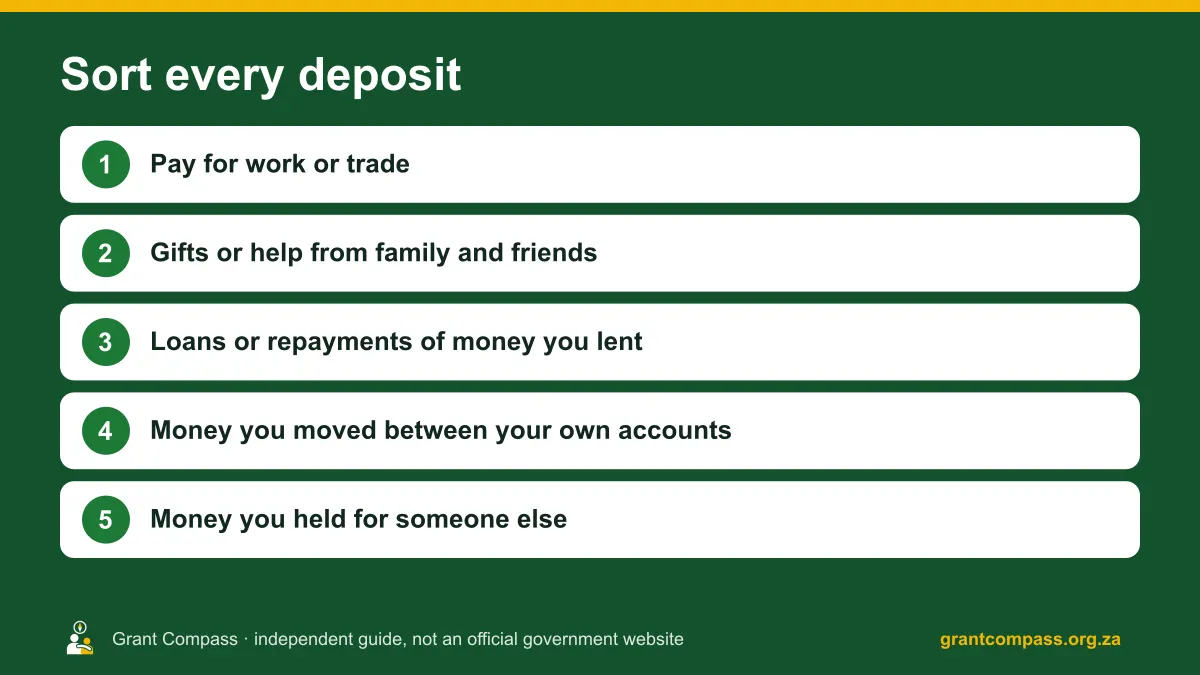
Step 4: Sort each deposit
Give each one a label: earnings, gift, loan, refund, own transfer or held for another person.
Step 5: Find proof
Match each non-earning amount with a document or message.
If you see an account you never opened, contact the bank immediately and report suspected fraud to SASSA on 0800 701 701.
What do the income-related messages mean?
Several messages sound alike but need different answers.
| Message theme | What it is about | Your move |
|---|---|---|
| Alternative income | Money or support found | Check statements and appeal if wrong |
| UIF | Unemployment insurance records | Confirm with UIF |
| NSFAS | Student funding records | Confirm with NSFAS |
| Bank details pending | Payment details missing | Add your own account |
| Identity failed | Who you are could not be confirmed | Verify identity |
Read Declined for UIF if your reason names the fund. For all other reasons, see Why SRD was declined.
How do you appeal an income decline?
Appeal online for each declined month, generally within 90 days of the decision. The Independent Tribunal for Social Assistance Appeals considers it.
- Open https://srd.sassa.gov.za/appeals, or https://srd.dsd.gov.za.
- Enter your ID number and registered phone number.
- Type the code sent by SMS.
- Choose the month.
- Pick the reason that best fits an income dispute.
- Explain the deposits plainly.
- Add documents if the form allows.
- Submit and save the confirmation.
See the full Appeal steps and How to read outcomes.
What should your explanation say?
State the month, the amount, the source and why it was not your income. For example: "The R800 on 4 September was moved from my savings account. Statements for both accounts are attached." Only claim what you can show.
Will a perfect explanation always win?
No. Appeals may rely on database checks, and the tribunal makes the decision. Civil society groups have criticised how appeals handle evidence. Submit your proof anyway and keep copies in case you need advice later.
Can you qualify again next month?
Yes, if your records for that month meet the rules. A single deposit does not ban you for life.
Watch the next result carefully. If the same refusal repeats although nothing came in, ask SASSA what it is seeing. Take current statements with you. You may also need to follow a reapplication or Reconfirmation instruction if the portal shows one.
How is this different from other grant means tests?
SRD uses a simple monthly check, while permanent grants such as the old age grant look at income and assets through a fuller application. Do not apply one grant's limits to another.
Our guide to the SASSA means test explains the wider rules. If you also care for a child, the Child support grant has its own conditions.
What should you do about piece jobs and small trading?
Keep honest records, because earnings from casual work are still income. Some months may qualify and others may not.
Use a small notebook with date, job, amount received and costs paid. Records help you explain your real position if you are asked. If you earn money regularly, accept that you may not qualify for those months. For ideas that fit a tight budget, see Small business ideas, and weigh the effect on your grant.
People on public works stipends can read about EPWP pay and SRD.
What if you share money in a household?
Shared household money can land in your account and look like your own income. This happens easily when one person holds the only account.
Think about rent contributions, grocery money, funeral collections or school fees that others send through you. For each one, keep the message from the sender and the proof of where it went. Money arriving and leaving in the same week tells part of the story, but it may not change a database result.
The safer habit is to have each adult receive their own money. If that is not possible, keep a monthly note with names, amounts and purposes.
| Situation | Better habit |
|---|---|
| Relative sends school fees through you | Ask them to pay the school directly |
| Housemates send rent to you | Ask them to pay the landlord, if allowed |
| Funeral or church collection | Use the group's own account where one exists |
| Friend wants pay sent to your account | Decline, and suggest they open their own |
What if the same month keeps being refused?
Check the status of each month separately and keep a record of every reason. A repeat can come from a lasting record rather than a new deposit.
- List the refused months in order.
- Compare each with your statements.
- Note any month with no money in at all.
- Appeal that month and say that nothing came in.
- Ask SASSA what source it is relying on.
- Contact that source, such as your bank or a former employer.
A month with empty statements and an income refusal deserves a close look. It may point to an account you do not know about, or a record that was never updated.
Where can you get help with an income decline?
SASSA offices, the toll-free line and free advice organisations can help you understand the process. They cannot promise a result.
Call 0800 60 10 11 and ask what you can submit. Visit a local office with statements if you cannot use the website. Community advice offices and legal clinics may help you write your explanation. Hide account numbers on copies you show to anyone who does not need them, but keep full originals for official use.
Before you share a statement, check that the person is really entitled to see it. Our SASSA offices guide helps you plan a visit.
How should you plan if a month is refused?
Plan your budget as though the money may not come until a decision says otherwise. An appeal takes time and may not succeed.
Tell anyone who depends on that money early, and avoid borrowing against a hoped-for result. If food is the urgent problem, ask a local office or community organisation what other relief exists near you. Keep following your newer months, since one of them may be approved while the older one is still under appeal.
Tips to avoid income surprises
These habits make your accounts easier to explain.
- Check statements monthly. Review money in before you forget the reasons. Ten minutes is usually enough.
- Do not lend your account. Friends may ask to receive money through you. Say no politely.
- Keep your pockets simple. Many accounts and wallets create many trails. Close ones you do not need.
- Label transfers. Use a clear reference such as "own savings". It helps you explain later.
- Save SMS records. Wallet messages can disappear when you change phones. Screenshot them.
- Ask senders for notes. A short signed note with date and purpose is useful. Ask at the time.
- Be honest about support. Never invent a loan or gift story. False information can bring penalties.
- Watch for unknown accounts. Fraud can create records you did not make. Report it early.
- Appeal on time. Do not wait for every document. Check the deadline first.
- Keep bank secrets private. No official needs your PIN or app password to check income.
What if someone offers to clean your record?
Refuse, because nobody can legally edit a government or bank check for a fee. Such offers usually aim at your money or identity.
SASSA says it will never ask for your PIN. Do not send ID photos, codes or card numbers to anyone promising approval. Use official numbers when you need help: 0800 60 10 11, or [email protected].
Frequently Asked Questions
What is SASSA income verification?
It is the check SASSA runs to see whether you had income or support that affects SRD eligibility. It uses information from banks and government databases. The check relates to a particular month, so results can change. You agree to this verification when you apply for the grant.
How much money can I have to get SRD?
The threshold has been R624 a month. A court case about that rule was still unresolved when we checked on 26 November 2026. Income is only one condition, so staying below the amount does not guarantee approval. Confirm the current rule on official channels before relying on it.
Does money from family count as income?
It can be picked up as money you received. A High Court found that gifts and once-off payments should be excluded, but that ruling was appealed. Record who sent it and why. If you were declined because of family help, appeal and explain it with whatever proof you have.
Why was I declined when I did not work?
Money can enter your account without any job. Gifts, loans, refunds, your own transfers or money held for someone else may all show up. An outdated or wrong record can also cause refusal. Check every account for that month, label each deposit and appeal if the decision is wrong.
Can SASSA see my eWallet transactions?
We could not confirm exactly which wallet services are checked. SASSA does state that applicants consent to verification of income and bank accounts. Treat money linked to your ID or phone as something you may need to explain. Keep the messages that show who sent it and why.
Does transferring my own savings affect my grant?
Moving your own money is not new income, but it can look like a deposit on one account. If refused, get statements for both accounts showing the money leaving and arriving. Explain the transfer briefly in your appeal. There is no guarantee, but a matching trail is strong support.
How do I appeal alternative income source identified?
Use the SRD appeals page, enter your ID and phone details, choose the declined month and select the matching reason. Explain which deposits were not earnings and add proof if allowed. Appeal within 90 days of the decision, and submit a separate appeal for every affected month.
Do I need three months of bank statements?
For an SRD income appeal, focus on statements that cover the declined month for every account. Extra months may help show that a payment was once-off. Permanent grant applications often ask for three months, so check which grant you are dealing with before collecting papers.
Will closing my bank account fix an income decline?
No, closing an account does not erase what happened in a past month. It may also leave you without a way to be paid. Keep your payment account open and correct. Deal with the refusal through proof and an appeal, and only change banking details when there is a real reason.
What if the income SASSA found is not mine?
Ask your bank whether any account or deposit linked to your ID is unfamiliar, and report suspected fraud. Appeal the month and say clearly that you do not recognise the income. Keep bank confirmations and reference numbers. Call 0800 701 701 to report fraud involving your grant.
Your best next step
Get statements for all your accounts for the declined month, and label every deposit today. Then lodge the appeal with the clearest proof you have. Check your newer months in the SRD status check so a repeat does not slip past you.
Sources
- You and Your Grant (SASSA booklet 2026)
- GroundUp: Rules regulating SRD grant are unconstitutional, court finds
- GroundUp: Decision on basic income support delayed until court ruling
- SASSA statement on declines and biometric verification
- SRD appeals information

About The Author
Michael Williams is an informational content writer focused on South African social grants, SASSA services and public assistance information.
Keep Reading