The most workable small business ideas for SRD beneficiaries use skills and tools you already have: cleaning, laundry, simple food, gardening, recycling or typing help. Start tiny and test whether neighbours will pay. Remember that earnings can affect your monthly SRD check, so keep honest records from the first sale.
Contents (11 topics)
- Where are you starting from?
- Eight ideas worth testing
- How to test an idea with very little money
- How do you know whether you made money?
- Will business money affect your SRD grant?
- Do you need a permit or registration?
- Where can you get real support?
- What if the business is not working?
- Tips for earning extra safely
- Frequently Asked Questions
- Your best next step
Where are you starting from?
Match the idea to what is already in your home. This avoids spending grant money on equipment before you know anyone wants the service.
| If you have | An idea to test | Main risk |
|---|---|---|
| Time and a strong back | Cleaning or yard work | Irregular bookings |
| Water, a basin and an iron | Laundry and ironing | Utility costs |
| A stove and kitchen skill | Snacks or lunches | Food safety and unsold food |
| A patch of ground | Vegetables and herbs | Slow harvest and water |
| A smartphone and good reading | Typing and online form help | Handling private information |
| A busy street nearby | A small table or tuck shop | Stock that does not move |
No idea on this page promises an income. What sells in one street may fail in the next.
Eight ideas worth testing
Pick one idea only. Two or three at once split your money and attention.
1. Laundry and ironing
Offer a set price per basket. Agree on collection, return day and who supplies soap. Count electricity and water, because they can swallow your profit.
2. Home or yard cleaning
Offer one clear job, such as floors and bathrooms. Ask what the customer expects before you quote. Tell a family member where you are working.
3. Vetkoek, snacks or lunch packs
Sell one or two items near workers or learners. Take orders the day before where possible. Keep food covered and your preparation area clean.
4. Vegetables and seedlings
Spinach, onions and herbs can be tried in a small bed or containers. Check water access first. Your first benefit may simply be spending less at home.
5. Recycling collection
Visit a buy-back centre before collecting anything. Ask which materials it takes, how clean they must be and what it pays. Heavy loads and long walks reduce the value of your day.
6. Typing, CVs and form help
Help neighbours type a CV or find an official website. Let them enter their own passwords and codes. Never keep copies of their ID documents on your phone.
7. Small tuck shop
Start with a few fast sellers, such as bread, eggs or soap. Track which items move within a week. Restock only those.
8. Repairs and sewing
Hemming, patching and basic repairs need skill more than stock. Practise on your own items first. Show examples when you ask for work.
How to test an idea with very little money
Prove that people will pay before you buy more. Follow these steps over two or three weeks.
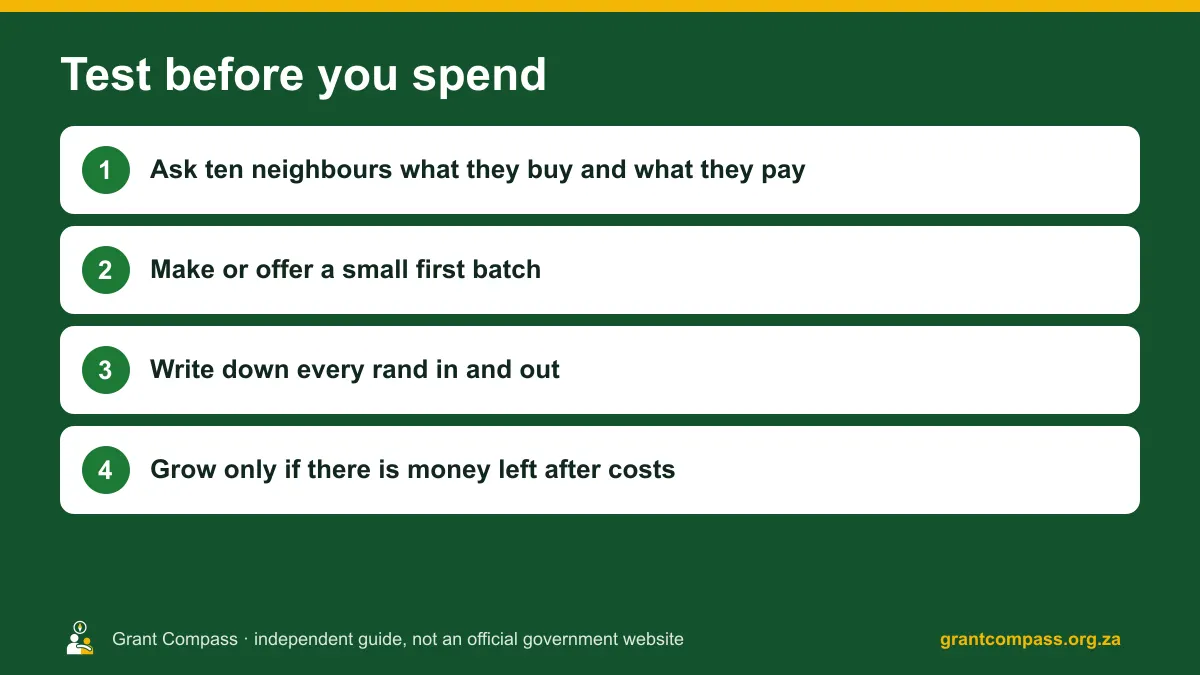
- Ask around. Speak to at least ten likely customers about what they buy now.
- Check prices. Find out what others nearby charge for the same thing.
- List your costs. Include materials, transport, power, packaging and spoiled items.
- Set a limit. Decide the most you can afford to lose, without touching food or medicine money.
- Run a small batch. Take orders or deposits where it is fair to do so.
- Count the result. Subtract all costs from money received.
- Decide. Continue, change the offer, or stop.
Do not borrow from a loan shark to start. Never hand over your ID, bank card or PIN as security.
How do you know whether you made money?
Sales are not profit. Profit is what remains after every cost.
Here is a made-up example to show the sum, not a forecast.
| Item for one batch | Amount |
|---|---|
| Money from 40 vetkoek at R3 each | R120 |
| Flour, yeast, oil and sugar | R55 |
| Gas or electricity | R15 |
| Packets and napkins | R8 |
| Money left over | R42 |
Now ask how long the work took. If R42 needed a full day, consider a better price, a cheaper supplier or a different product.
Keep a notebook with four columns: date, money in, money out and reason. Keep business cash apart from household cash, even if it is only in two envelopes.
Will business money affect your SRD grant?
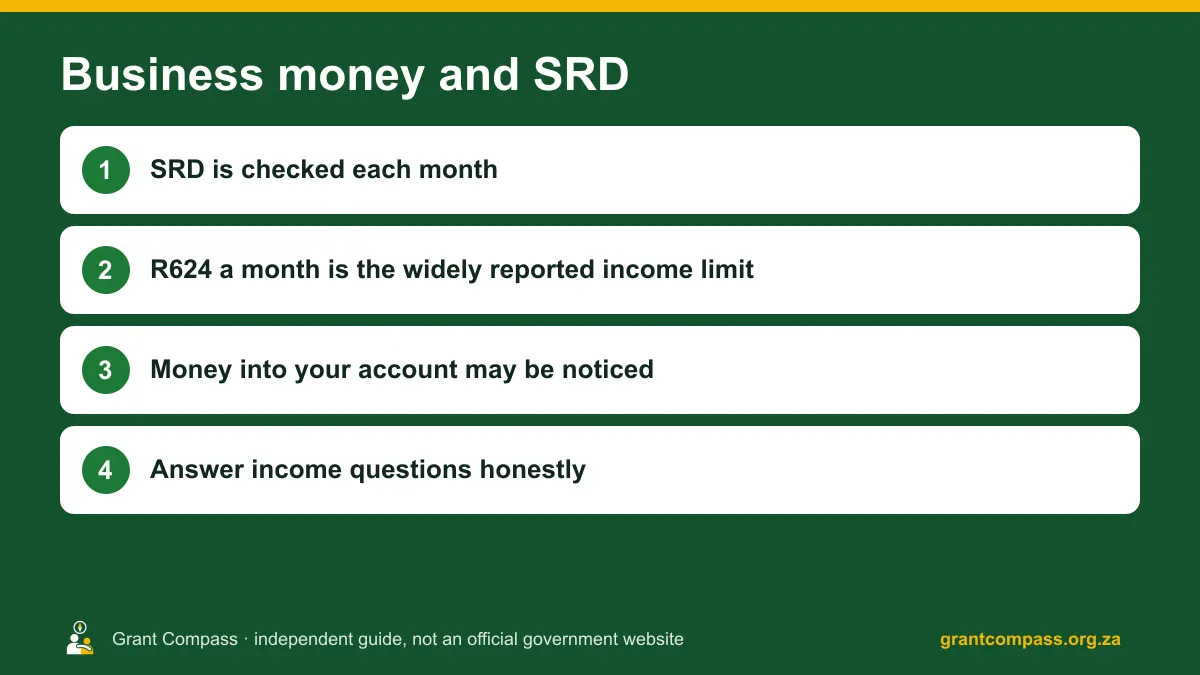
It can. SRD is meant for people with insufficient means, and your situation is checked each month.
R624 a month is the income limit widely reported as current. The Gauteng High Court found problems with SRD rules in January 2025, and government appealed. The appeal judgment was still awaited in late November 2026.
SASSA may check bank accounts and other records. We could not confirm exactly how it treats business sales compared with profit. If money for stock passes through your own account, records can matter.
Take these precautions:
- Answer income questions truthfully.
- Keep supplier receipts and your cash book.
- Expect that a good month may bring a declined result.
- Appeal if you believe the income was read wrongly.
Read how SRD income checks work and how to Lodge an appeal. If a month fails, Decline reasons may help you read the message.
Do you need a permit or registration?
It depends on what you sell and where. Ask your municipality before you trade.
Food: national food premises rules, known as R638, require a Certificate of Acceptability for places where food is handled. This can include a stall. Your municipal environmental health office handles it.
Street trading: many municipalities require an informal trading permit and limit where you may set up.
Home business: zoning or by-laws may restrict shops and workshops at home.
Company registration: registering is a separate choice from getting a local permit. A registration does not by itself let you trade anywhere.
Fees and rules differ by area, so ask for them in writing.
Where can you get real support?
Start with free advice before paid courses. Support programmes have their own conditions, and none is automatic for SRD recipients.
SEDFA
The Small Enterprise Development and Finance Agency supports small businesses. A government notice about the spaza fund lists its call centre as 012 748 9600. Ask about advice and training near you.
Spaza Shop Support Fund
This fund opened in April 2025 for qualifying spaza shops in townships and rural areas. Conditions include South African ownership, municipal registration and active management by the owner. Its call centre is 011 305 8080. Ask whether applications are still open.
Your municipality
Ask for the local economic development office. It may know of trading spaces, training days or recycling partners.
Work and training routes
A business is not the only option. Look at Learnerships, Free online courses or help with Writing a CV.
What if the business is not working?
Stop and look at your notebook before you spend more. A quiet week does not always mean failure, but repeated losses do mean something must change.
- Nobody buys: ask three people why, then change the product, price or place.
- People buy on credit and do not pay: limit credit or stop it.
- Costs keep rising: compare suppliers and reduce waste.
- You feel unsafe: change your hours or location, or stop.
Closing a small test is not a disgrace. You have learnt something while the loss is small.
Tips for earning extra safely
- Start with one offer. A simple price list is easier to explain and easier to cost.
- Charge for your time. If you only cover materials, you are working for free.
- Take deposits fairly. Give a written note of what was paid and what is due.
- Keep receipts. A shoebox works, as long as you use it every day.
- Protect your grant money. Cover food and medicine before buying stock.
- Meet new customers carefully. Share your location with someone you trust.
- Ignore lump sum promises. We found no official SRD option that swaps monthly payments for business capital.
- Never share codes. A "funding agent" who wants your OTP is not helping you.
- Review monthly. Compare money left over with the hours worked.
Frequently Asked Questions
Can I run a business while receiving SRD?
We found no rule that bans SRD applicants from trying a business. The issue is income. SRD is checked monthly, and earnings may lead to a declined month. Be honest when asked, keep records of sales and costs, and check the current rules before relying on the grant.
Which business can I start with the least money?
A service using what you already own is usually the cheapest to test, such as cleaning, ironing or typing help. You avoid buying stock that may not sell. Still count transport, data, soap or electricity. Ask possible customers first, so you know the work exists.
How much can I earn before SRD stops?
R624 a month is the income threshold widely reported as current, but the rule is being challenged in court. We cannot say how every type of business receipt will be assessed. A month showing money above the limit may be declined. Check official information and appeal errors.
Will SASSA give me a lump sum to start a business?
We found no official option that lets you exchange monthly SRD payments for one large business amount. Be careful of anyone asking for a registration fee to release such money. Government has spoken about linking recipients to enterprise support, but that is not a cash offer to apply for.
Do I need a permit to sell food?
Food handling premises generally need a Certificate of Acceptability under national regulation R638, and this can include stalls. You may also need a municipal trading permit. Visit your municipal environmental health office before you sell, and ask what inspections, fees and equipment apply in your area.
Is there government funding for spaza shops?
The Spaza Shop Support Fund was launched in April 2025 for qualifying shops in townships and rural areas. It has ownership, registration and compliance conditions, and receiving SRD does not qualify you by itself. Call 011 305 8080 to ask whether applications are open and what is required.
Should I use my SRD payment as capital?
Only use money that your household can truly spare. R370 often has urgent jobs to do, and a new business can lose money. Consider a service that needs no stock, or take small advance orders. Never skip medicine or food to buy goods you hope to sell.
Where can I get free business advice?
Ask SEDFA about advisers and training near you, and ask your municipality's local economic development office about local programmes. Libraries and community centres may also post training notices. Confirm that a course is free before you attend, and do not pay anyone promising guaranteed funding.
Does registering a company stop my grant?
Registering and earning are different things, and we found no published rule saying registration alone ends SRD. A registered business can still show up in records and carries duties of its own. Think about whether you need it yet, and give true information about money you receive.
What records should I keep?
Write down every sale and every cost with its date. Keep supplier slips, permit papers and any bank statements. Mark which money is for restocking and which you kept. These records show whether the business works, and they may help you explain your income if a month is declined.
Your best next step
Choose one idea and ask ten possible customers about it this week. Write their answers down before you spend anything. Then check your latest result on the SRD status page, so you know where you stand before extra money starts coming in.
Sources
- SAnews: Guideline to apply for the R500 million Spaza Shop Support Fund
- Government Gazette: Regulations R638 on food premises
- City of Cape Town: Apply for a certificate of acceptability
- SASSA booklet: You and Your Grant 2026
- GroundUp: Decision on basic income support delayed until court ruling

About The Author
Michael Williams is an informational content writer focused on South African social grants, SASSA services and public assistance information.
Keep Reading