To report the death of a SASSA beneficiary, register the death, then tell SASSA the person's name, grant type and date of death. A grant is payable until the last day of the month of death. Next of kin have six months to apply for any unclaimed amount.
Contents (12 topics)
- Where do you start after the death?
- How do you report the death to SASSA?
- Which documents should you take?
- When does the grant stop?
- How do next of kin claim unpaid money?
- What if money arrives after the death?
- What if the person cared for a child or acted for someone else?
- What if the person received the SRD grant?
- What can go wrong, and how do you fix it?
- Tips for families dealing with a grant after a death
- Frequently Asked Questions
- Your best next step
Where do you start after the death?
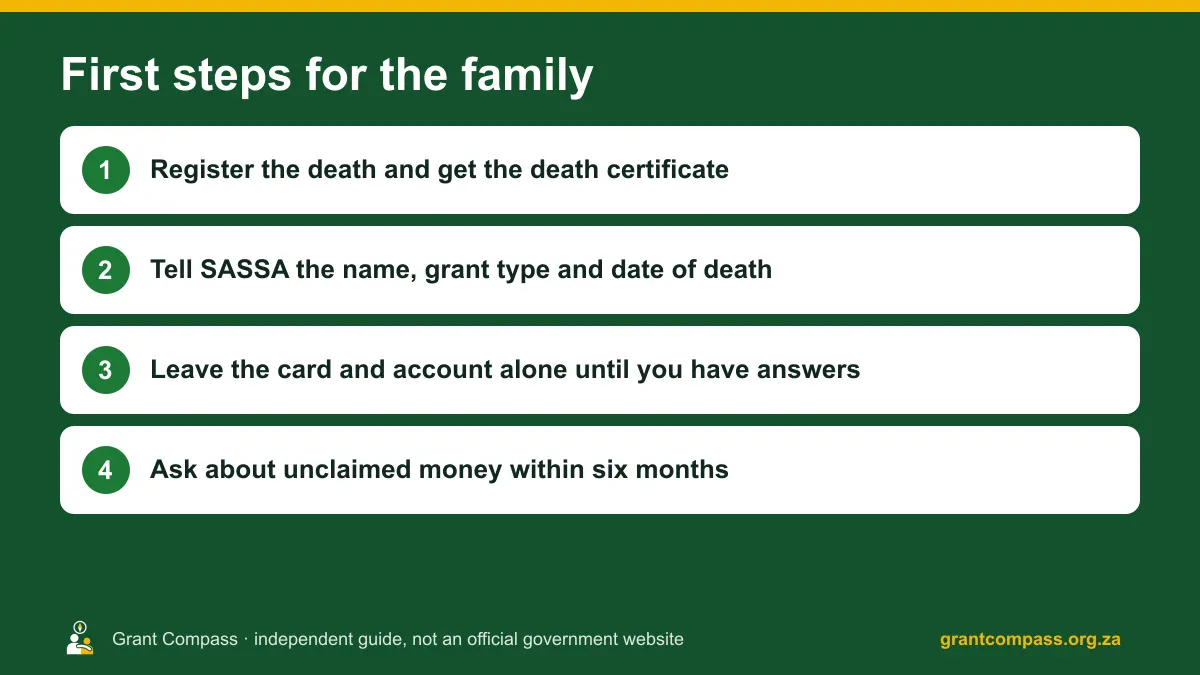
Start with the death registration, then contact SASSA as soon as you can. You do not need to have every paper ready before you make the first phone call.
The registration rules expect notice of a death within 72 hours. A funeral undertaker often helps the family with this, and Home Affairs issues the death certificate. Ask for certified copies, because banks, insurers and SASSA may each want one.
Do not assume that the undertaker, the clinic or the bank has told SASSA. Make the report yourself and note when you did it.
How do you report the death to SASSA?
Visit a SASSA office or phone the toll-free line to ask how your local office wants the report. An office visit lets you hand in the certificate and get proof.
- Phone 0800 60 10 11. Say that a grant beneficiary has died and ask what to bring.
- Gather your papers. Take the death certificate, both IDs and any grant letters you have.
- Visit the office. Tell the official the date of death and the grant type.
- Ask about money. Check whether any amount for the month of death is still unpaid.
- Ask for the claim form. Next of kin must apply for unclaimed benefits.
- Keep proof. Write down the reference number, the date and the official's name.
You can also email [email protected] to ask for guidance. For branch details, use our guide to SASSA local offices.
What can you say on the phone?
Keep it short. You might say: "I am reporting a death. My relative received a grant and died on this date. Please tell me how to submit the certificate and how next of kin claim unpaid money."
Warning: do not send ID copies or a death certificate to a number or email address from a forwarded message. Use only official SASSA contacts.
Which documents should you take?
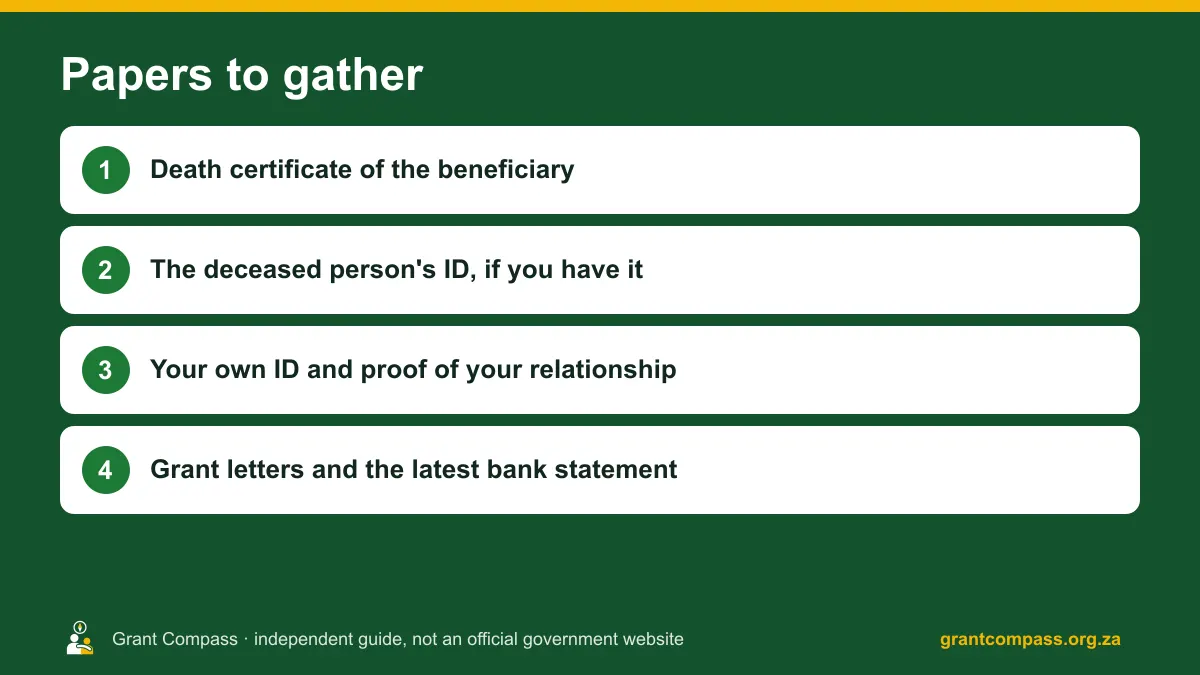
Take the death certificate and proof of who you are, then add anything that links you to the grant. SASSA may ask for more, depending on the case.
| Document | Why SASSA may want it | If you do not have it |
|---|---|---|
| Death certificate | Confirms the death and the date | Ask when Home Affairs will issue it and what SASSA accepts meanwhile |
| Deceased person's ID | Finds the right grant record | Give the ID number from old letters or statements |
| Your ID | Shows who is reporting | Ask Home Affairs about temporary identification |
| Proof of relationship | Supports a next of kin claim | Ask whether an affidavit is acceptable |
| Grant letters or statements | Shows grant type and payments | SASSA can search with the ID number |
A funeral programme or newspaper notice is not a substitute for official proof. Still, report the death even while you wait for the certificate.
When does the grant stop?
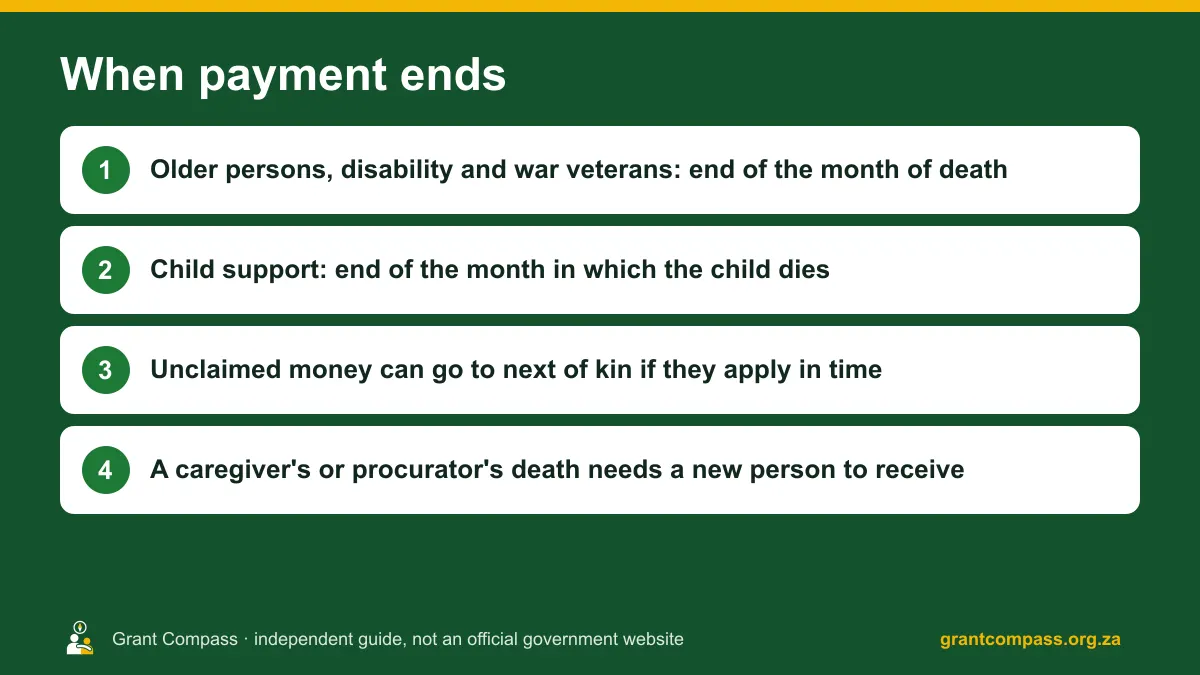
Older persons, disability and war veterans grants lapse on the last day of the month in which the beneficiary dies. A child support grant lapses on the last day of the month in which the child dies.
A foster child grant lapses at the end of the month in which the foster child dies. A care dependency grant lapses at the end of the month in which the care-dependent child dies.
So the month of death still counts. If someone dies on 5 November, the assistance is payable up to 30 November. Later months are not due.
How do next of kin claim unpaid money?
Next of kin must apply to SASSA within six months after the death. The regulations say unclaimed benefits are paid to the next of kin only when that application is made in time.
- Ask at the office whether an unpaid amount exists.
- Ask who SASSA accepts as next of kin and what proof is needed.
- Hand in the application and keep a copy with a date stamp.
- Note the six-month deadline on a calendar.
- Follow up until you receive a clear answer.
This is money that was already due for the person or child. It is not a funeral benefit or a death payout. We found no SASSA funeral grant for beneficiaries, so be careful with anyone offering to claim one for a fee.
What if money arrives after the death?
Check which month the payment belongs to before anyone touches it. A payment for the month of death differs from a payment for a later month.
Phone SASSA with the date and amount. If the money is for a month after the death, ask how to return it. Money paid to someone not entitled to it is owed to the State. The Act says it can also be recovered from a deceased person's estate.
Using the card or PIN after the death can create serious trouble, even for a close relative. Instead, tell the bank about the death and ask how the account is handled in the estate. Our article on Grant repayment demands explains how recovery works.
What if the person cared for a child or acted for someone else?
Tell SASSA straight away that others still depend on this grant. The Act says that when a parent, primary caregiver or procurator who receives a grant for another person dies, SASSA must appoint someone to receive it. It must do so without suspending the grant, subject to conditions.
In practice, expect to give documents and to show who now provides care. The new carer of a child should ask about taking over as primary caregiver. Our guide on The child grant after a caregiver's death walks through this.
If an orphaned child now lives with a relative, ask about the Extra amount for orphans. If the person who died was your procurator, read Who can collect for you before choosing again.
What if the person received the SRD grant?
Report the death to SASSA in the same careful way and say that the person was on SRD. SRD is temporary assistance with its own monthly checks, so ask how any pending month will be handled.
Do not log in as the deceased person to confirm, appeal or change bank details. Ask SASSA to close the record. Our SRD status guide explains the official channels.
What can go wrong, and how do you fix it?
Most problems come from missing proof or a report that was never captured. Each has a practical fix.
The grant keeps showing as active
Return with your reference number and ask whether the death was captured. Ask for the report to be escalated if payments continue.
A living person is marked as deceased
This is urgent and needs Home Affairs as well as SASSA. See our guide to Proof of life and "deceased" errors.
Relatives disagree about who may claim
Ask SASSA what proof of next of kin it accepts. Do not sign statements you have not read. A legal advice office can help with estate disputes.
Nobody gives you an answer
Put the complaint in writing. Our page on Raising a service problem shows the next level.
Tips for families dealing with a grant after a death
- Choose one contact person. One relative should report and follow up, so messages stay clear.
- Diarise six months. Write the claim deadline down on the day you learn the rule.
- Keep certified copies. Several offices may ask for the certificate at the same time.
- Leave the card alone. Put it somewhere safe until SASSA and the bank advise you.
- Save statements. They show what was paid and for which month.
- Refuse paid helpers. Do not hand money or papers to someone who offers to speed up a claim.
- Ask about dependants. Raise any child or adult who relied on the grant during your first visit.
- Write everything down. Note names, dates and reference numbers after each call.
Frequently Asked Questions
How soon should I report a beneficiary's death to SASSA?
Report it as soon as you reasonably can, ideally once you have started the death registration. Early reporting helps stop payments that are not due and reduces repayment problems later. If the certificate is not ready, phone 0800 60 10 11 and ask what SASSA can record in the meantime.
Does SASSA pay for the month in which the person died?
Yes. The regulations say social assistance is payable until the last day of the month in which the beneficiary or child dies. Payments for later months are not due. If an amount for the month of death was not collected, next of kin can apply for it within six months.
Who can claim the unclaimed grant money?
The next of kin of the beneficiary or child may receive unclaimed benefits, if an application is made within six months of the death. SASSA decides what proof it needs. Take your ID, the death certificate and anything showing the relationship. Ask for the application at a SASSA office.
Is there a SASSA funeral benefit?
We found no SASSA funeral benefit in the Act or regulations. The rules provide for unclaimed grant money, which is a different thing. Funeral policies are private insurance products. If the deceased paid premiums from the grant, contact that insurer about a claim and ask for the policy document.
Can I keep using my late mother's SASSA card?
No. Do not use it. The grant belonged to her and ends after the month of death. Money still due must be claimed through SASSA by next of kin, and money in a bank account forms part of estate matters. Ask SASSA and the bank what to do.
What happens if we report the death late?
Payments may continue before SASSA's records catch up. Money paid for months when nobody was entitled to it can be recovered, including from the estate. Report now, give the true date of death, keep the funds untouched and ask SASSA which months it regards as overpaid.
Can I report the death by phone only?
A call is a good first step, but SASSA is likely to need the death certificate or other proof. Ask the agent how to submit it and which office to visit. Keep the reference number. We found no single official online form for reporting a grant holder's death.
What happens to a child grant if the child dies?
The child support grant lapses at the end of the month in which the child dies. Report it with the child's death certificate. If you receive grants for other children, those are separate and each depends on its own child. Ask SASSA to confirm they are unaffected.
Does a grant pass to the widow or widower?
No. A social grant does not transfer to a spouse. The surviving partner may qualify for assistance in their own right, such as an older persons or disability grant, after a separate application and means test. A change in marital status must also be reported if they already receive a grant.
What if I live far from a SASSA office?
Phone 0800 60 10 11 and explain your difficulty. Ask whether a nearer service point can accept the documents or whether another relative may deliver them. Do not give originals to a stranger travelling to town. Ask for confirmation once the office has received the report.
Your best next step
Phone SASSA today, report the date of death and ask how next of kin apply for unpaid money. Then take the certificate to the office and keep your reference. Other contact routes are on our SASSA contact page.
Sources
- Social Assistance Regulations, 2022 (Government Gazette 46459)
- Social Assistance Act 13 of 2004
- Births and Deaths Registration Regulations, 2014
- SASSA grant booklet 2026 (You and Your Grant)
- SASSA services portal: contact us

About The Author
Michael Williams is an informational content writer focused on South African social grants, SASSA services and public assistance information.
Keep Reading