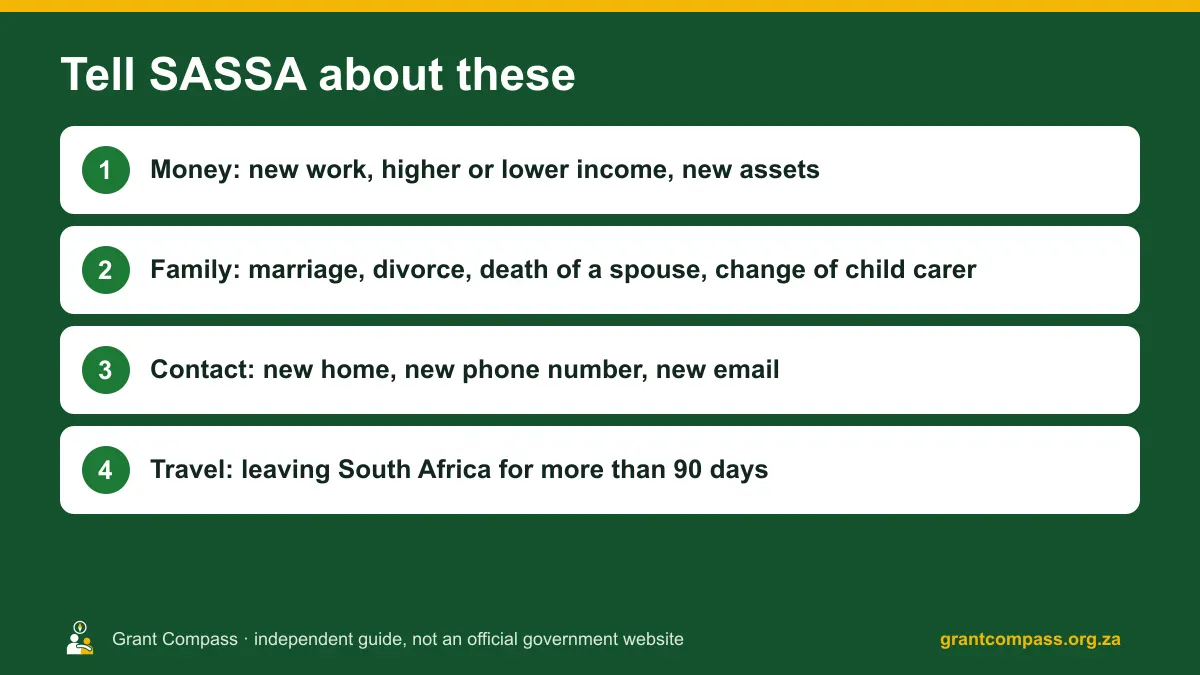
The main changes to report to SASSA are changes to your money, marriage, home, contact details, care of a child and time outside South Africa. The law says to tell SASSA as soon as reasonably possible. Telling SASSA does not automatically stop a grant, but hiding a change can cost you.

Contents (17 topics)
- What has changed in your life?
- Why do you have to report changes at all?
- How do you report a change to SASSA?
- Which money changes should you report?
- What if your marital status changes?
- Moving house or to another province: what must you do?
- How do you update a phone number or bank account?
- What if the child no longer lives with you?
- Does a hospital stay affect your grant?
- Who can receive your money while you are ill?
- What if you are leaving South Africa?
- What if you miss a notice or the grant stops?
- Do you need to report a death in the family?
- What if several things change at once?
- Tips for reporting changes without trouble
- Frequently Asked Questions
- Your best next step
What has changed in your life?
Start with the event, because it tells you what to take and how urgent it is. Use this table to find your situation.
| If this happened | What SASSA needs to know | Proof that may help |
|---|---|---|
| You found or lost work | New income and the date it changed | Payslip, appointment or termination letter |
| You married, divorced or were widowed | Your new marital status | Marriage, divorce or death certificate |
| You moved house or province | New physical and postal address | Utility bill or letter from landlord, chief or councillor |
| You changed your number or email | New contact details | Your ID |
| You opened a new bank account | New account details | Three months of statements showing your name and number |
| A child moved to another carer | New care arrangement | Affidavit or school and social worker letters |
| You will be abroad for over 90 days | Dates, address and reason | Travel and medical papers |
SASSA may ask for more than this. Treat the last column as a starting list.
Why do you have to report changes at all?
Your grant is based on facts that can change, and the Social Assistance Act makes you responsible for updating them. If information in your application materially changes, you must inform the agency as soon as reasonably possible.
A person who knowingly fails to do so commits an offence under the Act. SASSA may also recover money paid when you no longer qualified. Our guide to being Asked to pay back a grant explains that side.
Reporting can also work in your favour. If you ask for an increase and SASSA agrees, it applies from the date you asked. A fall in income is therefore worth reporting too.
How do you report a change to SASSA?
Visit a SASSA office with your ID and proof, or ask on the toll-free line which channel fits your change. SASSA also runs an online services portal at services.sassa.gov.za, though not every change can be made there.
- Write the change down. Note what happened and the exact date.
- Phone 0800 60 10 11. Ask which documents are needed and whether you must visit.
- Collect proof. Make copies and ask which ones must be certified.
- Visit the office. Tell the official you are updating an existing grant, not applying again.
- Ask for a reference. Get a receipt, stamp or the official's name.
- Read what comes next. Watch your phone and post for a review date or a decision.
You can also email [email protected]. Never email or message your PIN, and do not post ID copies on social media.
Warning: SASSA says it will never ask for your bank PIN. End any call or chat that asks for it.
What if you cannot visit in person?
If you cannot come yourself, or a visit would cause undue hardship, you may appoint a procurator by power of attorney. Read Who can collect or act for you before you choose someone.
Which money changes should you report?
Report any change in your financial position, including your spouse's if you are married. This covers wages, self-employment, a private pension, rent received, investments and property.
- A new job, extra shifts that raise your pay, or a business that starts earning
- Losing work or a drop in wages
- A pension, policy payout or inheritance
- Buying or selling property
- A spouse starting or stopping work
Not every deposit is income. A once-off repayment from a friend differs from a monthly wage. Still, SASSA can check bank records, so keep notes that explain unusual amounts.
What happens if your grant goes down?
When you report a financial change that lowers your grant, the decrease takes effect from the first day of the month after the change. SASSA must tell you the new amount and the reasons.
You get a 30-day period to ask for the decrease to be reviewed, according to the regulations. The Act also gives 90 days to ask SASSA to reconsider a decision. Act early so that you meet the shorter date. Check how the Income test works before you argue a figure.
What if your marital status changes?
Report it, because SASSA looks at both spouses' money for many grants. Marriage can push household income above a limit. Divorce, desertion or a spouse's death can lower it.
Take the certificate that matches your event. Where a spouse deserted you, SASSA's booklet mentions an affidavit. Ask what else the office needs, especially for customary marriages.
Moving house or to another province: what must you do?
Tell SASSA your new address and phone number, even if you only moved across town. A move on its own is not listed in the regulations as a reason for a grant to lapse.
Do this around the time you move:
- Keep your old letters, SMS notices and any review request.
- Get proof of the new address, such as a bill or a letter from the councillor or chief.
- Ask which local office now handles your follow-ups.
- Check that your bank details and phone number are still correct.
The booklet warns that changes in address can be a reason for suspension, and so can missed verification. That is why silence is risky. Find a nearby branch through our SASSA offices guide.
What if a review notice arrives while you are moving?
Do not ignore it. Phone SASSA, give your new address and ask where you may attend. Keep the reference number. Our page on Preparing for a grant review lists what to gather.
How do you update a phone number or bank account?
Treat these as separate updates, because changing your address changes neither one. Make sure SASSA has a number you can actually answer.
For other social grants, ask at a SASSA office how to change your number. For the R370 SRD grant, a number change includes a face check. See the steps to Update your cellphone number.
SASSA asks for an active personal bank account in your own name that accepts electronic transfers. When you change accounts, take a recent three-month statement showing your name and account number. Do not close the old account until a payment has reached the new one.
What if the child no longer lives with you?
Report it quickly, because a child grant follows the person who actually cares for the child. A child support grant lapses at the end of the month in which the child leaves the primary caregiver's custody.
Tell SASSA about a new carer, a child moving to family elsewhere or an alternative care arrangement. The new carer must deal with SASSA in their own name. Our explanation of When the child grant stops covers the rest.
Does a hospital stay affect your grant?
A normal admission for illness, surgery or an accident is not the situation the reduction rule describes. The rule targets people admitted to a state-funded institution to be cared for and maintained.
The regulations define a state-funded institution as certain places wholly funded by the State:
- a prison
- a psychiatric hospital
- a home for older persons
- a drug dependency treatment centre
- a child and youth care centre
A general public hospital ward is not named in that definition. If you are unsure how your admission is recorded, ask the hospital social worker and SASSA.
How does the reduction to 25% work?
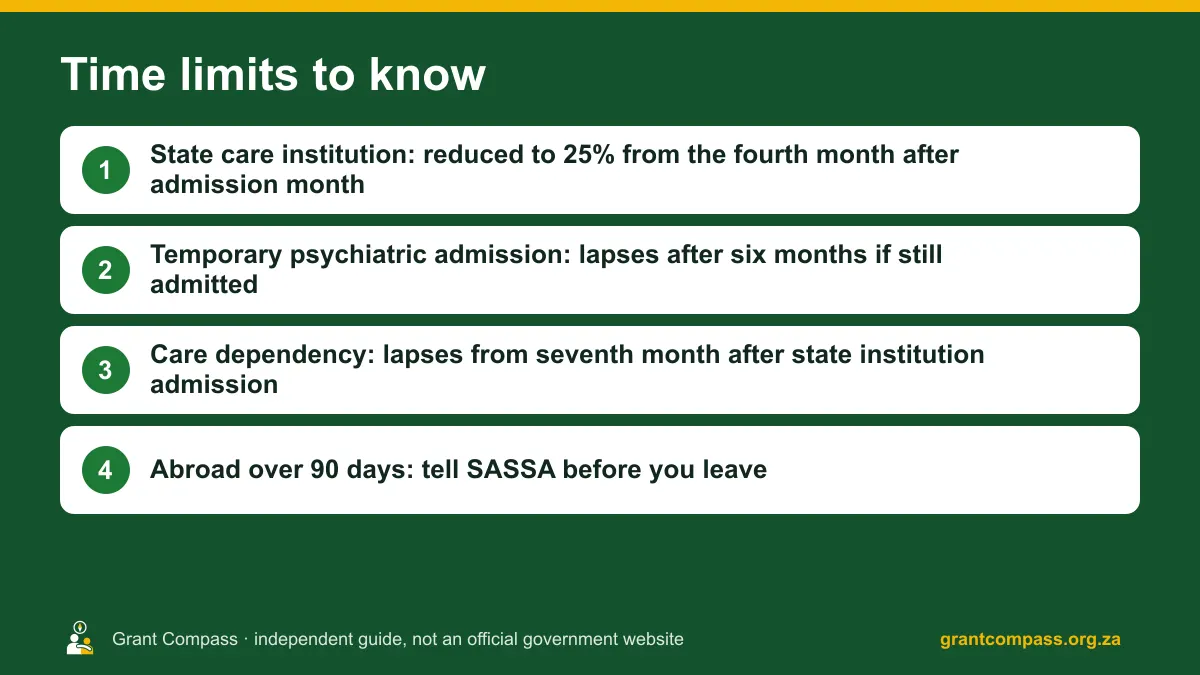
For an older persons, disability or war veterans grant, the amount drops to 25% of the maximum from the first day of the fourth month after the month of admission. Admission in January means the reduced amount starts on 1 May.
The full grant must be restored immediately from the date of discharge. Keep your discharge letter and show it to SASSA.
The same regulations also list admission to a state-funded institution among the ways these grants can lapse. The two provisions sit uneasily together. Get SASSA's answer for your own case in writing.
What about psychiatric and children's care?
A temporary psychiatric admission for observation or treatment has its own limit. The grant lapses six months after admission if you are still admitted.
A care dependency grant lapses from the first day of the seventh month after the child enters a state-funded institution. A grant-in-aid is not paid to someone maintained in such an institution. Check your Grant-in-aid if you move into care.
Which care rule applies to which grant?
Match the grant to the place of care before you assume anything about your payment.
| Grant and situation | What the regulations say | What to ask SASSA |
|---|---|---|
| Older persons, disability or war veterans: maintained in a state institution | Reduced to 25% from the fourth month; lapse is also listed | Which rule is being applied, and from what date |
| The same grants: temporary psychiatric admission | Lapses after six months if still admitted | How the admission is recorded |
| Care dependency: child in a state institution | Lapses from the first day of the seventh month | Whether any interim payment can be authorised |
| Grant-in-aid: maintained in a state institution | Not payable | When payment can resume after discharge |
Who can receive your money while you are ill?
You can authorise a person to be paid for a short period, or appoint a procurator for longer. Do not simply lend your card and PIN.
If illness or temporary incapacity stops you from receiving the grant, you may apply to have it paid to a person you authorise. This cover lasts no longer than three months in a row. Ask SASSA for the form. A procurator is the route for longer inability or undue hardship.
What if you are leaving South Africa?
If you plan to be away for more than 90 days, you must inform SASSA before you leave. The Act says payment is then suspended until you appear in person and confirm that you have returned permanently.
You or your procurator may ask in writing for payment to continue. SASSA can agree only on conditions it sets. The booklet and regulations mention reasons such as:
- medical treatment outside the country
- a doctor certifying that you are unfit to travel back
- reasons beyond your control, not including lawful arrest or detention
SASSA may also ask you to report at a South African mission or designated office while away. If payment continues, follow every condition and send each update on time.
What if an emergency keeps you away longer?
Send SASSA a sworn statement immediately after the emergency arises. Say when you left, where you are, why you cannot return, when you expect to be back and how to reach you. Attach proof.
If you stay silent, SASSA may suspend the grant and recover payments for the period beyond 90 days. You then have 90 days from the posting of the notice to explain.
Does the SRD grant travel with you?
No. The SRD grant is for people who live within South Africa's borders. If you have moved abroad, do not keep claiming it. The SRD application guide sets out the other conditions.
What if you miss a notice or the grant stops?
Find out the exact reason first, then act inside the time limit. A review, a missing document, an out-of-date record or a real change in eligibility each need a different fix.
If SASSA asks for information and you do not provide it, payment may be suspended. This can happen within 30 days of the notice. The regulations then give 30 working days to apply for restoration. Follow our guide to Restoring a stopped grant.
For other suspensions or cancellations, SASSA must generally give 30 days' notice and a chance to explain. Fraud and misrepresentation are treated differently.
Do you need to report a death in the family?
Yes. The death of a beneficiary or of a child on whose behalf a grant is paid ends that grant at the end of that month. The death of your spouse also changes your marital status. See Reporting a beneficiary's death for the steps and the claim deadline.
What if several things change at once?
Report all of them together, because one life event often causes others. A death, a divorce or a job in another town can change your address, income, marital status and care arrangements at the same time.
Write one list before your visit and tick off each item with the official. For example, a move for work may involve:
- a new address and postal code
- a new employer and income
- a new phone number
- a child who now stays with a grandparent
- a new bank account
Ask the official to read back what was captured. If you receive more than one grant, name each grant, so that the change reaches every record it affects.
Tips for reporting changes without trouble
- Report early. Phone or visit as soon as you know the date of the change. Waiting can create an overpayment.
- Keep a change diary. Write the date, office, official and reference number each time.
- Update one thing at a time. Name every change out loud so that none is missed on the form.
- Take originals and copies. Hand over copies and keep your originals unless SASSA says otherwise.
- Check your phone. Review notices can arrive by SMS, so keep your number working.
- Carry discharge papers. They prove the date your institutional stay ended.
- Plan travel with margin. A trip close to 90 days can overrun, so speak to SASSA before you leave.
- Ignore fixers. Updating your record does not require a payment to a stranger.
- Ask for reasons. A written decision is easier to challenge than a conversation at a counter.
Frequently Asked Questions
What changes must I report to SASSA?
Report changes to your financial position, marital status, physical address, contact details, care arrangements for a child and the child's primary caregiver. Also tell SASSA before an absence from South Africa longer than 90 days. If you are unsure whether something counts, report it and let SASSA decide.
How soon must I tell SASSA about a change?
The Act says as soon as reasonably possible after the change happens. It does not give one fixed number of days for every change. For travel longer than 90 days, you must tell SASSA before leaving. Keep proof of the date you reported, in case somebody questions it later.
Will SASSA stop my grant if I get a job?
Not automatically. SASSA must look at your income against the limit for your grant type. Your grant may continue, be reduced or end, depending on the result and the grant. Report the job with your payslip. Keeping quiet risks an overpayment that you may be asked to repay.
Do I need to apply again if I move provinces?
A move is not listed as a reason for a grant to lapse, so do not submit a second application on your own. Give SASSA your new address and contact details. Ask whether anything else is needed and which office will handle your future reviews and enquiries.
Will my pension be cut if I am in a public hospital?
Ordinary treatment in a general ward is not named in the definition of a state-funded institution. The 25% rule applies to people admitted to such an institution to be cared for and maintained. Ask SASSA and the hospital social worker how your own admission is classified.
How long can I be outside South Africa and keep my grant?
The key limit is 90 days. If you intend to be away longer, you must inform SASSA first and payment is normally suspended. SASSA may allow continued payment in limited cases, on written request. Tell it about shorter trips too if there is any risk of delay.
Can I report a change by phone?
You can phone 0800 60 10 11 to ask what to do, and SASSA may direct you to an office for the actual update. Bank details, marital status and similar changes normally need documents. Ask the call agent for a reference number and note the date and time.
What documents should I take?
Take your ID plus proof of the specific change, such as a payslip, certificate, proof of address or bank statements. If you are married, SASSA may also ask for your spouse's ID and income proof. Phone first so that you do not travel twice for one missing page.
What if SASSA does not update my record?
Go back with your reference number and ask what is outstanding. Put your complaint in writing and keep a copy. If SASSA has made a decision you disagree with, you may ask for reconsideration within 90 days of learning about it, and appeal after that if needed.
Does reporting a change delay my payment?
It can if SASSA needs to check documents or review your eligibility, but a report does not by itself mean a delay. Ask the official whether your next payment is affected. Report bank changes well before a payment date, and keep the old account open until money arrives.
Do SRD applicants have to report changes too?
Yes. SRD applications are checked against income and other records, and your details must stay correct. Use the official SRD site at srd.sassa.gov.za for SRD updates. If your circumstances mean you no longer qualify, ask SASSA how to cancel instead of continuing to receive payments.
Your best next step
Pick the one change you have not reported yet and phone 0800 60 10 11 to ask what proof to bring. Then visit with copies and leave with a reference number. If you cannot get through, try the routes on our Contact SASSA page.
Sources
- Social Assistance Act 13 of 2004
- Social Assistance Regulations, 2022 (Government Gazette 46459)
- SASSA grant booklet 2026 (You and Your Grant)
- Social Assistance Amendment Act 5 of 2010
- SASSA services portal: contact us

About The Author
Michael Williams is an informational content writer focused on South African social grants, SASSA services and public assistance information.
Keep Reading